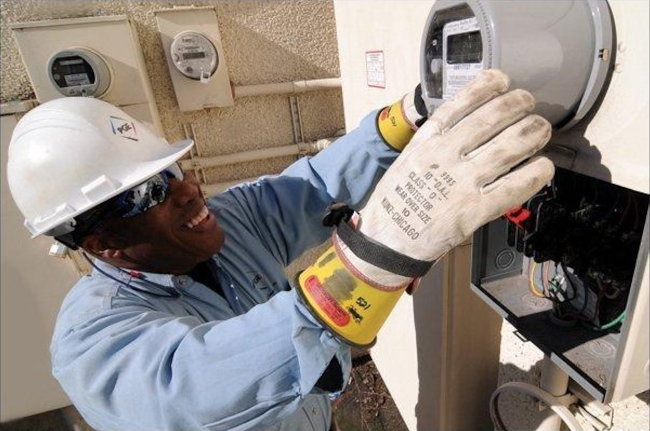
PGE says three small meter fires have been reported in its service territory, with minor property damage in one case. It mailed out letters to affected customers this week and aims to have the affected meters replaced by the end of October.
The electrical component failures are limited to a subset of smart meters that it installed between 2010 and 2012. The affected model number is the Sensus 2S Gen3 RD, mostly installed in rental units where PGE needed the ability to turn them on and off remotely. Customers can call PGE at 877-835-1435 or check online at pgemeterexchange.com
to check if they have one of the affected meters.
PGE embarked on a major smart meters installation program in 2008, and the other 785,000 meters installed with residences and businesses don't have the same issues, it says.
Bill Nicholson, PGE's Senior Vice President of Customer Service, said PGE first became aware of potential problems in 2013 and hired two separate consultants to evaluate the meters. Its initial testing was inconclusive, but it shared its results with the manufacturer,
North Carolina-based Sensus, and asked for help.
"They are not recalling these," Nicholson said. "This is our choice. This is our decision based on our assessment and our tests. We believe this risk is small, but it's totally unacceptable to us."
Nicholson said swapping out all the meters would take three months because PGE and its suppliers don't have adequate replacements in inventory.
Reports of smart meter malfunctions, explosions and fires, meanwhile, have cropped up around the country and the world, including some meters manufactured by Sensus, a leading manufacturer of the technology.
SaskPower, a utility in Saskatchewan, Canada, is in the midst of a province-wide smart meter program using Sensus meters. But it suspended that initiative two weeks ago following six fires tied to meters in the last two months.
PECO Energy in Philadelphia also replaced all its Sensus smart meters in 2012 after several of them overheated and caught fire, two of them resulting in serious house fires, according to the Philadelphia Inquirier.
Sensus was also sued in 2010 in Alabama for false claims by an employee who alleged he was fired after refusing to remain silent about the company's defective meters. The suit alleged that Sensus and two electric utilities sought federal grant funding despite knowing the meters were faulty. The suit was dismissed after the employee settled the case in 2011, according to Law360.
Sensus spokeswoman Linda Palmer did not respond to the Oregonian's query on whether the company felt the meter in question was safe. In an emailed statement, she said it was working with PGE to understand what led to "the issue" and engaging with them on a solution.
"The industry, as a whole, has experienced meter issues for years." she said. "Given that there are more than 40 million meters deployed to date in North America, the failure rates are very low.
"There are approximately 10 million Sensus meters in North America operating safely and reliably. We are evaluating the small number of issues and we remain committed to providing safe products..."
Smart meters are touted as a critical technology to modernize the electrical grid, promote distributed generation and help customers use energy more efficiently.
Ratepayer advocates in Oregon questioned whether smart meter technology was ready for prime time when PGE first proposed spending $135 million of ratepayers money to replace all its meters in 2008. Those reservations had to do with functionality, not safety, however.
PGE had already been down the smart meter path, installing 3,500 earlier in 2001 that it junked in favor of the new models. Besides slashing meter reading costs, PGE said the new meters, with two-way communications, would provide a platform for future programs to better manage electricity demand.
Data from the meters does allow customers to get on line and check yesterday's energy use. But other, more sophisticated demand response programs, with real time date that allows customers to adjust their usage on the fly, have yet to arrive.REGINA – It looks like SaskPower ratepayers will not be on the hook for the cost of replacing 105,000 defective smart meters.
Saskatchewan Premier Brad Wall says the government will go after the manufacturer, Census, for a portion of the $14-million cost.
The province is pulling the plug on the power meters due to public safety concerns following at least eight fires.
SaskPower has been ordered to remove any smart meters already in use and install the old ones.
Saskatchewan’s Crown Investments Corp. has been asked to investigate and SaskPower is conducting an internal review.
The problem in Saskatchewan has prompted officials in Medicine Hat, Alta., to suspend installation of electricity smart meters in that city.
“We’re going to be pursuing redress from the company in whatever way we can,” Wall said Thursday.
“We can start with negotiations and, if that doesn’t work, we’ll take the next step.”
SaskPower initially gave people the option of switching back to their old power meters. About 530 customers took the utility up on the offer.
The Opposition NDP has said the Saskatchewan Party government did not do its due diligence before going ahead with the devices.
A smart meter records consumption of energy in small intervals and can relay the information electronically to a utilities company.
It eliminates the need to estimate bills when a meter reader can’t do an on-site check.
In Medicine Hat, communications officer Wilbur McLean, said crews have wrapped up about 95 per cent of 29,000 smart meter installations on the electrical side with no problems.
He said each installation has had mandatory requirements.
“One, there’s a visual inspection of the meter socket, which is part of the house where the meter is installed,” McLean said.
“The second thing we do is we have a photograph taken of every single socket, send that to the utility and inspect it again.”
The third requirement is to have each meter equipped with a silent alarm.